Addresse
25 rue Lenepveu
49100 Angers
Paddle board yoga!

Welcome to the world of paddle board yoga, also known as SUP yoga (Stand Up Paddle yoga): a practice that blends the gentleness of yoga, the thrill of paddleboarding and the magic of nature. Whether you are an experienced yogi looking for new sensations or simply a water lover who wants to try something different, here is everything you need to get started with confidence.
What exactly is paddle board yoga?
Paddle board yoga is simply practising yoga on a stand up paddle board, floating on calm water: a lake, a pond, a sheltered bay or a gentle river. Your board becomes your mat, and every pose is reinvented.
The big difference with a regular yoga class? The surface moves. Slightly, but constantly. As a result, your body has to keep adjusting its balance, which turns every asana into a much deeper workout for your stabilising muscles, your abs and your concentration.
The discipline arrived in France from the Californian and Hawaiian coasts in the early 2010s. Today it appeals to a very wide audience: curious yoga practitioners, paddlers who want to slow down, athletes looking for a gentle but demanding activity, and anyone who loves reconnecting with the water.
The benefits of SUP yoga
SUP yoga combines, in a single practice, the benefits of yoga, paddleboarding and being out in nature. Here are the main benefits of paddle board yoga.
A unique proprioceptive workout
On a stable surface, some poses can go on autopilot. On a board, nothing is a given: every movement engages your deep muscles, your ankles and your core. That is exactly what makes paddle board yoga so effective for improving balance, core strength and joint stability.
Complete, impact-free muscle strengthening
SUP yoga works almost your entire body: abs, back, glutes, legs, shoulders. Because you are on the water, there is no impact on your joints — the ideal way to ease back into exercise, or to complement a more intense practice.
A real mental break
Practising in the middle of nature, far from notifications, car horns and screens, changes everything. Simply being on the water lowers your heart rate, slows your breathing and encourages a meditative state that many describe as “ten times more powerful than in a studio”. Several studies have also shown that simply being close to water (a “blue space”) reduces stress and improves mood.
Sharper focus
Holding a pose while your board sways forces you to be 100% present. You think about your breath, your centre, what is happening right now.

Key takeaway
A 1-hour SUP yoga session can burn between 350 and 500 calories depending on intensity — more than a regular yoga class, thanks to the constant stabilising work.
The ideal equipment for paddle board yoga
You can do paddle board yoga on any board… but some are much better suited than others.
The board
For SUP yoga, choose a wide board (at least 32-34 inches, i.e. ~80-86 cm), a thick one (~15 cm) with a generously sized non-slip foam deck. The more volume the board has, the more stable it is.
The paddle
Normal
0
false
21
false
false
false
FR
X-NONE
X-NONE
/* Style Definitions */
table.MsoNormalTable
{mso-style-name:”Tableau Normal”;
mso-tstyle-rowband-size:0;
mso-tstyle-colband-size:0;
mso-style-noshow:yes;
mso-style-priority:99;
mso-style-parent:””;
mso-padding-alt:0cm 5.4pt 0cm 5.4pt;
mso-para-margin:0cm;
mso-pagination:widow-orphan;
font-size:11.0pt;
font-family:”Calibri”,sans-serif;
color:#111518;}
A standard stand up paddle is all you need. During the session, you will lay it across the board most of the time so you don’t lose it. A floating paddle is a real plus.
Safety essentials
- A suitable buoyancy aid (or a compact belt pack if you want more freedom of movement).
- A leash connecting your ankle to your board — essential, even on flat water.
- Environmentally friendly sunscreen (“ocean-friendly” formula).
- A towel and water to rehydrate after the session.
Good to know
If you rent your equipment at one of our self-service Playa Rent stations, you get a highly stable board, a buoyancy aid, a paddle and a leash: exactly what you need to try SUP yoga without investing in your own equipment.
5 paddle board yoga poses for beginners
Normal
0
false
21
false
false
false
FR
X-NONE
X-NONE
/* Style Definitions */
table.MsoNormalTable
{mso-style-name:”Tableau Normal”;
mso-tstyle-rowband-size:0;
mso-tstyle-colband-size:0;
mso-style-noshow:yes;
mso-style-priority:99;
mso-style-parent:””;
mso-padding-alt:0cm 5.4pt 0cm 5.4pt;
mso-para-margin:0cm;
mso-pagination:widow-orphan;
font-size:11.0pt;
font-family:”Calibri”,sans-serif;
color:#111518;}
You don’t need to be a pro to get started. Here are five poses that are particularly well suited to beginners.
Tabletop pose (Bharmanasana)
Normal
0
false
21
false
false
false
FR
X-NONE
X-NONE
/* Style Definitions */
table.MsoNormalTable
{mso-style-name:”Tableau Normal”;
mso-tstyle-rowband-size:0;
mso-tstyle-colband-size:0;
mso-style-noshow:yes;
mso-style-priority:99;
mso-style-parent:””;
mso-padding-alt:0cm 5.4pt 0cm 5.4pt;
mso-para-margin:0cm;
mso-pagination:widow-orphan;
font-size:11.0pt;
font-family:”Calibri”,sans-serif;
color:#111518;}
On all fours (knees and hands) on the board, back straight, gaze down at the board. Ideal for feeling the balance of the water and settling your breathing. This is the pose almost every session starts with.
Downward-facing dog (Adho Mukha Svanasana)
From tabletop, push your hips up into an inverted V. On the water, you immediately feel your postural muscles working differently than on the ground. It stretches the hamstrings and back, and tones the whole upper body.
Child’s pose (Balasana)
A precious resting pose in SUP yoga: sitting on your heels, upper body folded forward, forehead on the board, arms alongside your body. Perfect for resetting your breathing between two more challenging poses.
Warrior II pose (Virabhadrasana II)
The first standing pose: feet apart, front leg bent, arms stretched out to the sides. The great classic for opening the hips and grounding yourself. On the water, the challenge is real: your footing is constantly moving and your core is fully switched on.
Savasana on the board
Lying on your back, arms alongside your body, palms open to the sky. Let the water rock you.

Where to practise paddle board yoga in France
- Inland lakes — Lac de Madine, Lac de Créach Gwen in Quimper, Lac du Bouloc in the Hérault, Lac de Moulin Papon: smooth water, generally light wind in the morning, green surroundings.
- Sheltered Atlantic bays — Bay of Pornic, port of Larmor-Plage : a superb maritime setting in a sheltered environment.
- Calm rivers — some stretches of the Marne (Trilbardou) or the Agout offer perfect conditions in summer.
Safety first
Before each outing, check the weather forecast, the wind direction and the water temperature. Avoid windy conditions if you are a beginner. To find out more, read our complete guide to paddleboard and kayak safety — a few minutes of reading that can make all the difference to your outing.
Frequently asked questions about paddle board yoga
Do you need to be able to swim to practise SUP yoga?
Yes. It is an almost universal requirement among rental companies and instructors, and it makes perfect sense: even with a buoyancy aid, you are on the water, and falling in is almost inevitable. If you are not comfortable in the water, start by building your confidence in a swimming pool.
Do you need to know yoga already?
Not necessarily. Previous yoga experience helps you know the poses, but many people discover both disciplines at the same time through SUP yoga. Ideally, take a few classes on land and then try it on the water.
Can you practise in winter?
Technically yes, with a wetsuit, but it is best left to experienced practitioners. For a first try, wait until the water is at least 18 °C: it is more pleasant and safer.
What is the minimum age for paddle board yoga?
Most courses welcome participants from the age of 12-14, as long as they can swim. For younger children, choose a supervised class or a simple session paired with a parent. When renting from a Playa Rent station, the minimum age is 18.
BECOME AN OPERATOR
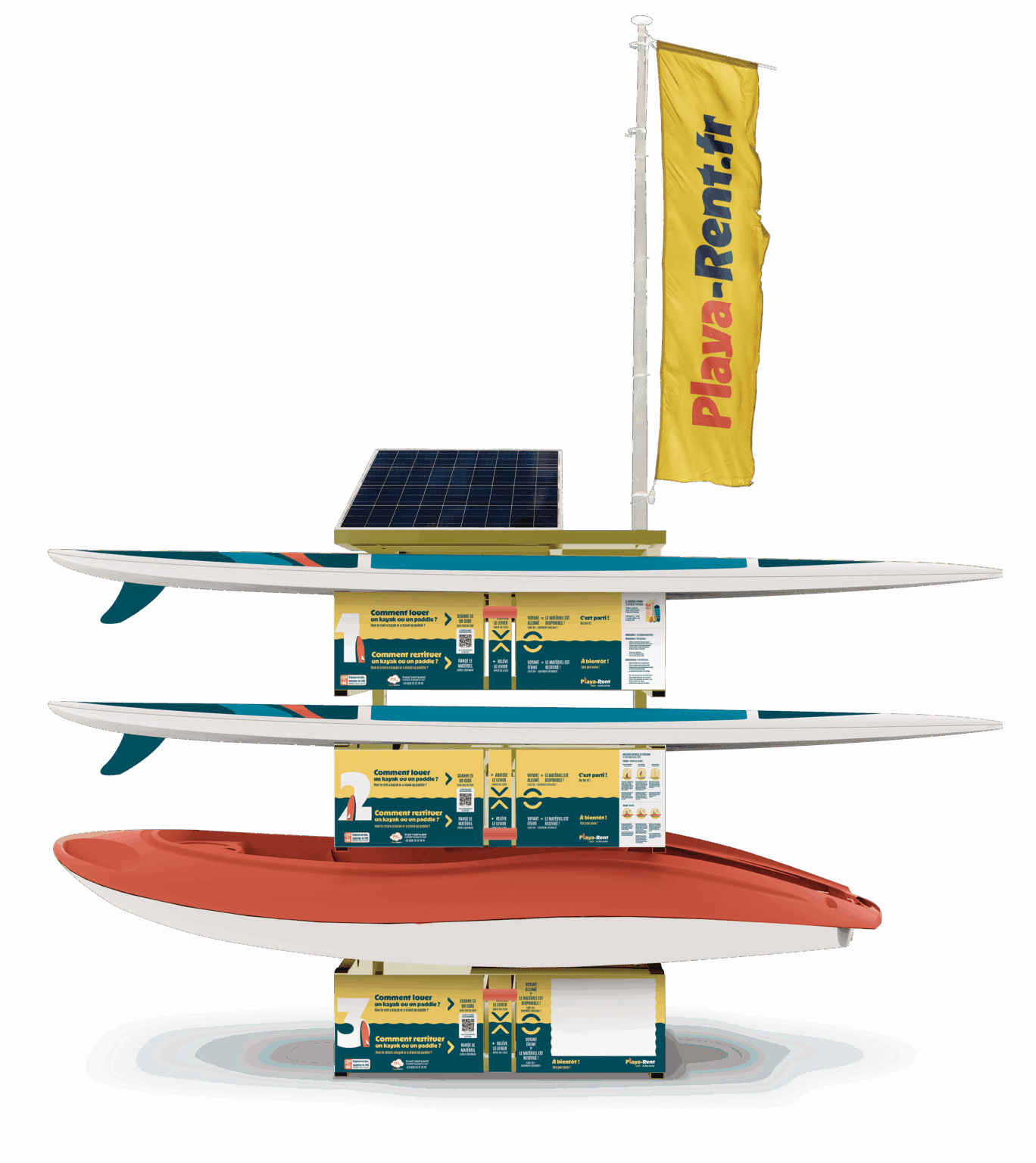
Install your self-service station now
Install your station and collect 100% of the revenue. Choose the equipment you want to rent out. Get it delivered, set your prices and you are good to go.
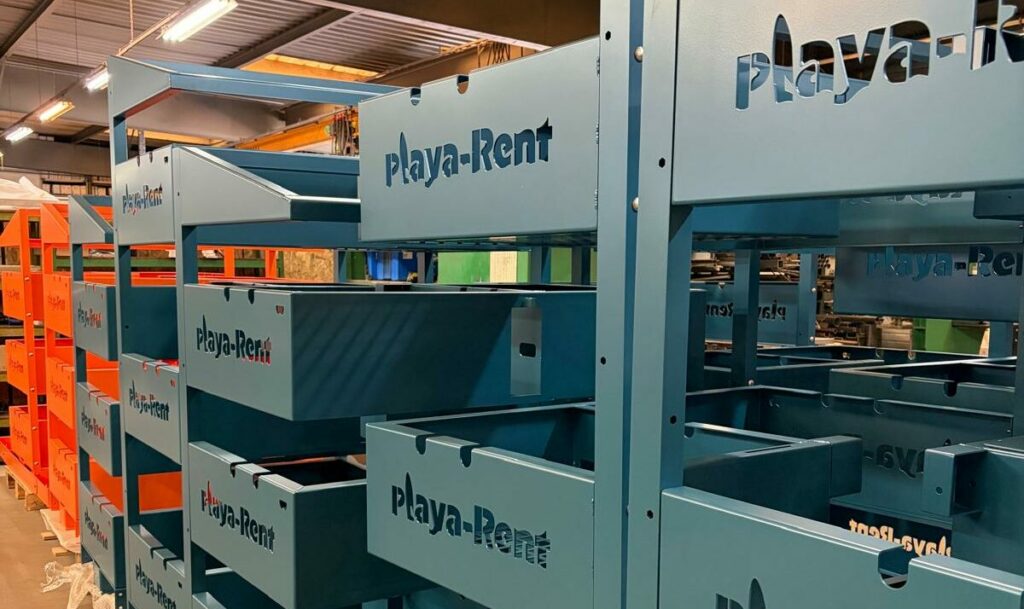
Find out how our stations are made
At Playa Rent, every station is the result of French expertise and a genuine commitment to quality. That is why we chose 100% Made in France manufacturing, working with local suppliers who share our standards and values. Our stations are designed and built to last and to provide our customers with quality equipment.
For us, making things in France is much more than a sales pitch: it is a conviction. By working hand in hand with local suppliers, we support the economy of our regions, reduce our environmental impact and guarantee full traceability of our products. Every Playa Rent station is the reflection of a fully controlled value chain, from design to delivery.